Showing posts with label Rome. Show all posts

Saturday, March 19, 2016

2015.05.13 Ostia Beach and the Mediterranean Sea

As we were walking back to the train station from Ostia Antica, I casually mentioned how close we were to the Mediterranean Sea. I'm not clear on what happened next, but that throwaway fact somehow led to the sudden decision to visit the seaside.

And this was how we ended up at Cristoforo Colobo Station, the end of the Roma-Lido line.

We had no map but did know that the sea was fairly close to the station. With only a general sense of direction, we got off the train and started walking. A family of tourists also headed in the same direction. Throughout our walk, I wasn't sure if we were following them or they were following us.

One parking lot, a crosswalk, and a set of nondescript stairs later, we made it to the Mediterranean Sea (more specifically, the Tyrrhenian Sea).

It was a weekday, so the beach was pretty empty with only a scattering of sunbathers and beachgoers. And no sighting of the infamous Italian men in speedos.


The water was so clear. It was beckoning me to take off my shoes, relax, and just enjoy the sunshine for a while

A multi-kite kite - I need to learn how to fly a kit just so I can get one of these. 

After our return to Rome, we made our way to the Spanish Steps.

A revisit for me, the steps and the adjoining piazza seemed a lot more crowded than I remember. 

People seemed to be content to just sit on the steps. One of the strangest things I saw was a group of tourists forming a protective circle around their hoard of shopping bags, not unlike prairie caravans in colonial times. I desperately wanted to take a photo but refrained. Curse you, common decency (or whatever it was)!

We then walked to the less-crowded, but no-less-deserved-of-love Piazza del Popolo to admire its Egyptian obelisk. The second oldest in Rome (Rameses II), it was brought to the city by Augustus in 10 BC. That's another great thing (perhaps the greatest) about ancient Rome. There have been great empires and kingdoms throughout history, but none expanded quite so vast and left such indelible marks (through structure... and the occasional pillaging) as did Rome.

Fountain of Roma at the Piazza del Popolo

Dinner: Pizza and seafood risotto takeout at the Cafe Washington. Delicious, especially when enjoyed in the hotel bed while reading "Hadrian and the Triumph of Rome". 

Saturday, March 12, 2016

2015.05.13 Ostia Antica (Ostia, Italy)

Ostia Antica showed up on my radar while searching "Daytrips from Rome" and it proved to be quite a gem (Thank you Internet!)

Once a bustling harbour town, it was eventually abandoned due to a shift in the coastline, similar to another famous ancient city, Ephesus in Turkey.

Only a 30 minutes journey from Roma central by train, both the site and transport were covered by the Roma Pass. A double bonus!

The train ride from the Piramide/Porta San Paolo station wasn't particularly scenic, since the Roma-Lido line is more of a suburban route.

Plus, Rome has a very serious (and visually-unappealing) graffiti problem.

If the tv show Rome can be trusted for historical accuracy, graffiti in Rome has been a long-held practice. I just wish there could be more graffiti art than the random taggings we saw all over town.


Beautiful cypress trees welcoming us to the ancient port city. Always a good sign when the site entrance is well-maintained.

Just outside the city gate is the Necropolis, the city cemetery. I'm trying to imagine travelling to ancient Ostia and passing by a huge graveyard before you even enter the city. It's a little spooky right (especially late at night)? Or is that just my own idiosyncrasies acting up? The Romans did both cremations and burials, depending on the period, hence the wall enclaves for the ashes.

Porta Romana
The main gate to the city. 

Base of a statue that used to stand by the gate. 

The inscription "SALVTI CAESARIS AVGVST GLABRIO PATRONVS COLONIAE D(ecreto) D(ecurionum) F(aciundum) C(uravit)" 

which reads,

"To the health of Caesar August, Glabrio, patronus of the colony, had this made by decree of the decurions"

Google Translator, by the way, needs serious work on their Latin translations.
Dedication on the gate. 

"SENATVS POPVLVSQVE ROMANVS/COLONIAE OSTIENSIVM MVROS ET PORTAS DEDIT/M. TVLLIVS CICERO CO(n)S(ul) FECIT CVRAVITQUE/P. CLODIVS PVLCHER TR(ibunus) PL(ebis) CONSVMMAVIT ET PROBAVIT/ PORTAM VETVSTATE CORRVPTAM"

"The Senate of Rome gave walls and gates to the colony of the Ostians; Cicero, when he was consul, oversaw the constructions; Clodius, arch-enemy of Cicero, finished the work when he was tribune of the people." 

An artist's rendering of what the gate used to look like. 

Warehouses

Remnants of the porticoed shops that used to line the main street (Decumanus Maximus). When it came to colonial urban planning, the Romans approached it with an uniformity also observed in their military.

A grid formation, with two major streets intersecting at a central square (forum).


The spectacular mosaic floor of the Baths of Neptune. Just to give a sense of scale, this photo was taken from two stories up and my camera still couldn't capture the entire image.

The rest of the bath, with another mosaic floor partially covered for restoration. You can (and should) check out the other mosaics here.

More shops...

The amazing preserved (and/or restored) Theatre. 
Note that only the first few VIP rows get the marble seats.

Square of the Corporations/Guilds (Piazzale delle Corporazioni)
The rooms surrounding the square are thought to be commercial offices. 

The interesting part of these "office spaces" are the floor mosaics in front of each, showing their respective trades. A form of advertisement, if you will.

A lot of ship and dolphin motifs. 

The exotic animals trade perhaps? Or ivory?

You know a site is worth visiting when school groups show up in droves. 

An offering altar (replica) in the Square of Corporations.

House of the Millstones
It looked like a mini-factory, with multiple millstones and giant stone bowls, which were part of "kneading machines", according to the online reference guide. 

A side-street. Very impressed at the straightness of the streets and buildings. And most of these buildings would have been at least two stories tall.

House of the Wine-bar...

...complete with a fresco promising food, wine, entertainment....

...and its own patio section. I wonder if it cost extra to sit outside like it does in modern Rome?

Photos taken from the top of an apartment complex (who knew ancient Rome had apartment complexes!?! I certainly didn't. And these apartment were tall, at least 3 stories. Oh, to be able to travel back in time to Rome's glory days...)

On our way to the on-site museum, we came across this. A storage facility - the jars were deliberately buried in the ground probably for temperature control.

Overall, I wasn't too impressed by the Ostia Antica museum but understandably so - it was hard to top our morning visit to the Capitoline Museum. Plus, I'm sure the horde of schoolkids rampaging through the rooms didn't help. (Aside: couldn't help but notice that all the kids' phones and cameras were better than mine.) 

Still, the museum offered a nice, A/C-ed (unusual for an Italian museum) break.

Capitolium. 
Built by emperor Hadrian (yay!), this was the primary temple of the city and dedicated to the god trio Jupiter, Juno, and Minerva

Forum

Directly facing the Capitolium was a temple dedicated to Rome and the emperor Augustus. 

We ended our tour with a visit to the always-fascinating latrines. And since the ancient Romans didn't have toilet paper, slaves cleaned the "patrons" with sponges on sticks. I am going to assume that the sponges were not reused. Because otherwise, it's just gross and not to mention unhygienic.

I finally got the chance to use Rick Steve's audioguide here and while the information provided was certainly interesting, I found it a little too simplistic. And the scripted banter between Rick Steve and the local guide got tiresome very quickly.

We pretty much covered most of the highlights listed in the tourist guide during our two-plus hour walk. Although in reality, we probably only covered 1/10-1/20 of the entire town.

Excavation and restoration are ongoing, so hopefully I'll get to revisit and explore the site in more depth.

Post-script:
General overview and highlights - http://www.ostia-antica.org/touristguide.pdf

Detailed descriptions of buildings - http://www.ostia-antica.org/dict.htm
Fair warning, if you enjoy reading about archaeological sites, be prepared to lose hours of your life just browsing. I've already bookmarked this website for later reading. I don't know whether to be happy or sad that they provide a ranking of the buildings (Gold - must-sees; Silver - worth a visit; and Bronze - of minor interest). If I had been aware of this list beforehand, my travel companions would have had a very difficult time convincing me to leave after just two hours. 

Saturday, March 5, 2016

2015.05.13 Musei Capitolini/Capitoline Museum (Rome, Italy)

The Capitoline Wolf has been on my list ever since my last visit to Rome. The statue depicts a she-wolf nurturing Romulus and Remus, the twin founders of Rome. Along with the letters "SPQR", the imagery has come to symbolize the city.

So we headed to the Capitoline Museum bright and early, taking the long way just so we can enter the museum square (Piazza del Campidoglio) via Michelangelo's famous Cordonata staircase.

Two beautiful Egyptian basalt lions guard the staircase entry. I wish I had taken photos close up because for a couple of 2,000 year-olds, they look amazing.  

The gradual incline of the Cordonata was designed to allow horseriders to climb up without dismounting.


Capitoline Wolf (Replica)
The real deal is inside the museum

The museum is divided into three sections: Palazzo dei Conservatori, Tabularium, and Palazzo Nuovo.

We entered through Palazzo dei Conservatori and our eyes went immediately to the colossal head in the courtyard.

Un-freakin'-believable.

It's one thing to see it in photos, a whole other experience to see it in person.

The head, along with the other body parts, is from the Colossus of Constantine, a seated statue that measured 12 meters high. Just the head itself is impressive enough! I can't even imagine how intimidating the statue looked when whole.
"The sky is that-a way."

Nike should definitely utilize this in one of their athletic footwear ads.  

Marcus Aurelius
One of the good emperors. A replica now greets visitors as they climb up the Cordonata and enter the piazza. This photo was taken for you LH. 

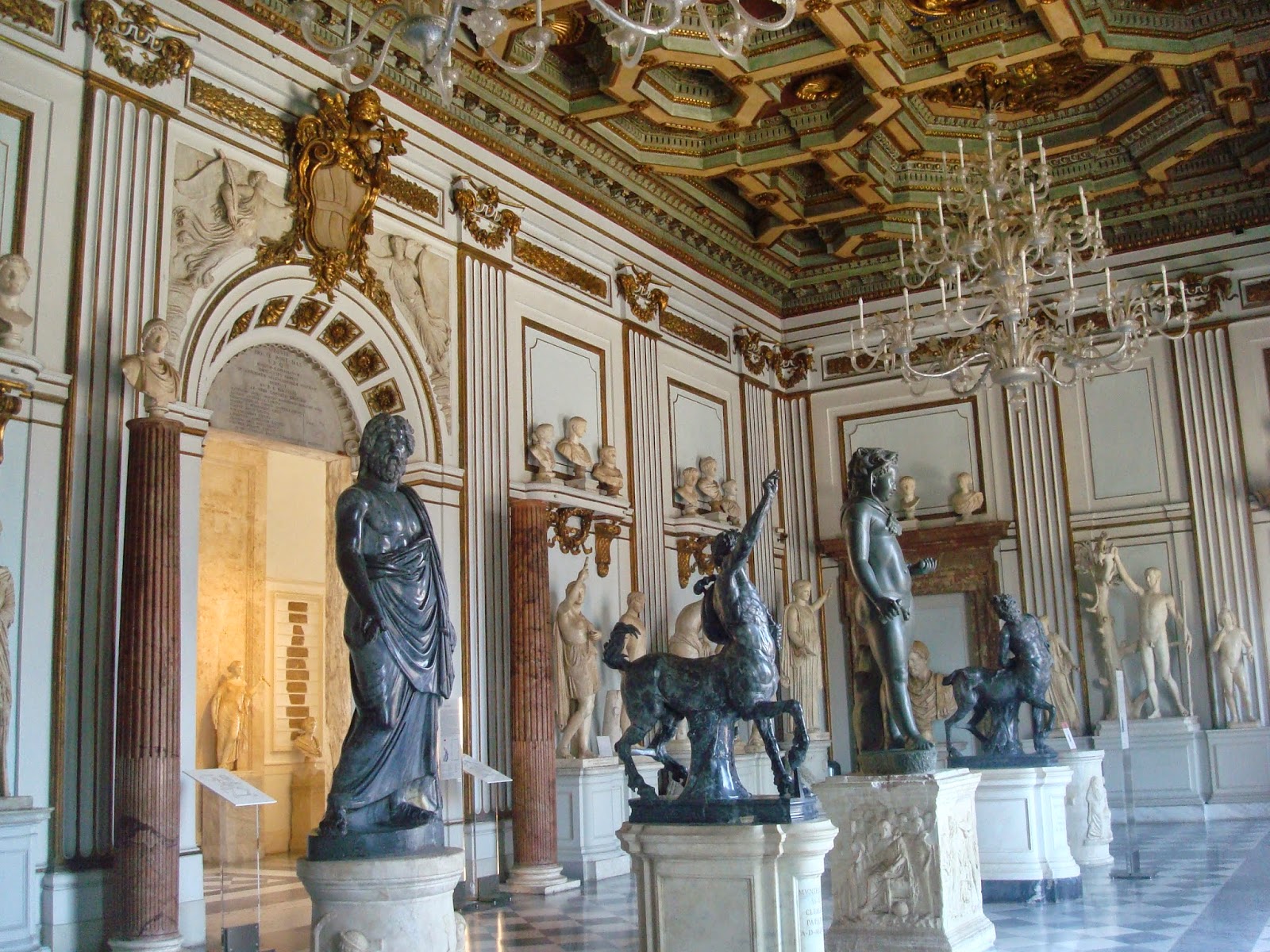
The Capitoline Museum's collection is small, especially when compared to that of the Vatican Museum, but full of masterpieces and beautifully-curated. 

Bernini's Medusa; Boy with Thorn (" Spinario")

Of course, it helps that the rooms displaying these artifacts are in themselves pieces of art.
I love the SPQRs all over the ceiling.

Capitoline Wolf again. But the original this time.

Bronze Hercules standing guard near the washrooms. 
Ready to clobber anyone who forgot to flush.

Relief of Marcus Aurelius in Triumph 

Note how his son Commodus, who should have been by his side on the chariot, has been chiseled out. And now I can't get the image of Joaquin Phoenix as Commodus out of my head. 


Lapidary Gallery

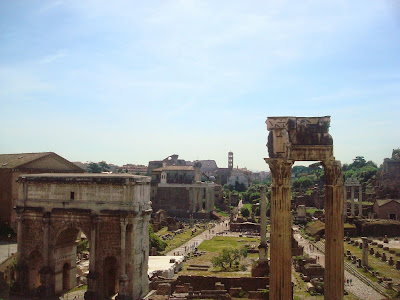
Tabularium, the state archives of ancient Rome, offered a fantastic view of the Roman Forum.

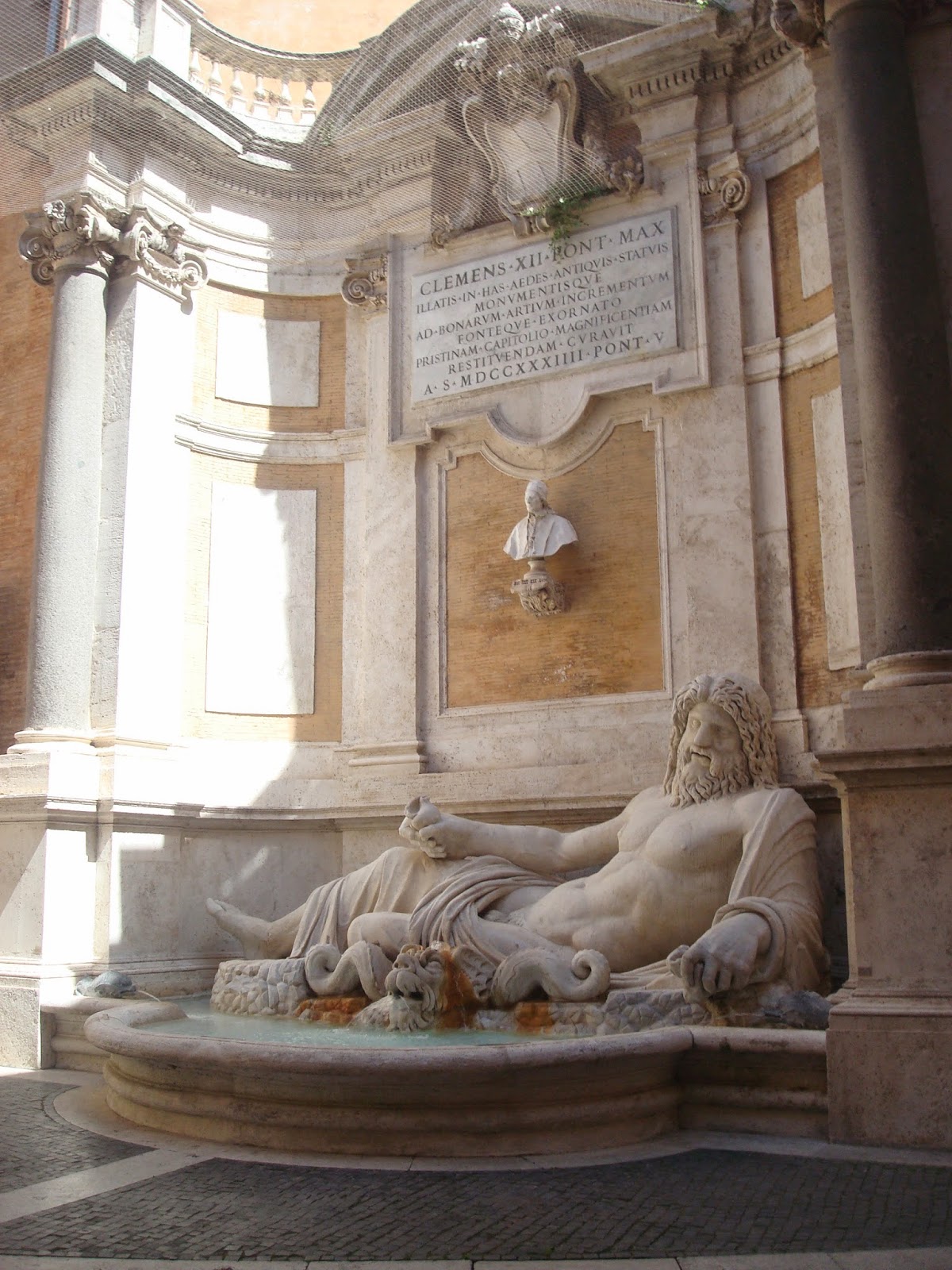
Palazzo Nuovo - Marforio

Marforio used to be one of the "talking statues" of Rome. Starting in the 16th century, satires and political criticisms would be posted, anonymously of course, on or near these statues, which would then be copied and highly circulated among the masses.

This group of statues were also known as the "Congregation of Wits".

Marforio is now part of a fountain and speaks no more.


I love these Egyptian monkeys. They make me smile.

Hall of statues; The Wounded Amazon 
(from the Villa d'Este, and one of many copies/reinterpretations of an original Greek sculpture)

A standout in the sea of white marbles - Faun in Rouge Marble. Originally from Hadrian's Villa in Tivoli, which we would visit the next day. 

A statue of baby Hercules that I find deeply unsettling. 
I don't know if it's his creepy face or his strangely proportioned half-baby half-adult body...

Stop staring at me, creepy baby.

Great Hall

Hall of the Emperors
Quite a number of busts were on loan to another museum, as can be seen from the voids, so alas, no Caesar, Augustus, or Hadrian. 

Hall of Philosophers

Mosiac of the Theatrical Masks

The mosiacwork is so fine that it has a painting-like quality. And in fact I did mistake it as a painting/extremely-well-preserved fresco when taking this photo. It came from Hadrian's Villa, along with another well-known mosiac masterpiece, Mosaic of the Doves (not pictured but also at the Capitoline Museum). This mosaic really gives you an idea of the opulence and mastery that decorated Hadrian's Villa, which would be sorely needed during our visit there.

To cap off the visit, the Capitoline Venus